
Tsubasa -RESERVoir CHRoNiCLE-, often shortened for the sake of convenience to “Tsubasa“, is one of the newest additions to a large body of work by world-renowned manga studio CLAMP. After 6 years of faithfully following this series’ serialization, I have come to the conclusion that it is nothing short of a masterpiece.
————————STORY: Tsubasa has an original and fresh story under its belt, which is to be expected from a CLAMP work. The main antagonist (Fei Wong Reed) causes a desert princess (Sakura) to lose all of her memories in order to achieve his dream. Her childhood friend (Syaoran) is forced to invoke the Space-Time Witch for help, because only through the Witch’s powers can he be sent to different dimensions in order to retrieve Sakura’s scattered memories. He is, by a stroke of fate and unmistakable destiny, accompanied by a swordsman (Kurogane) trying to get back to his homeland and back to the princess whom he serves (Tsukuyomi-hime). Syaoran is also accompanied by an enigmatic magician (Fay D. Fluorite) who is running from his dark past. To recompense the price for traveling worlds, they must each pay with the thing they value the most. Syaoran loses his relationship with Sakura forever, Kurogane gives up his precious sword, and Fay parts with the tattoo which keeps his magic intact. Along the journey, they encounter corrupt worlds full of bloodshed, despair, and lies. They find treachery and abandonment within their very own group. It is a story that sends a refreshing and ominous chill down one’s spine, particularly in the second half of the saga, which is savagely cruel. One should commence reading with the expectation that Tsubasa grows to be extremely dark and depressing. The story plays out to be almost worthy of Greek tragedy. It’s a fool’s game trying to predict how it ends. Tsubasa is definitely recommended for readers that enjoy magical adventures, fighting action, or forbidden romance.————————APPEAL: CLAMP excels at creating manga series that perfectly mesh the conventional attributes of shōnen and shōjo manga. Tsubasa is, like many of their works, a strong example of this fact. For guys, there are many “badass”, wondrously-illustrated fighting scenes, along with fantastic displays of weaponry in the splash pages and in the Infinity arc. The sheer amount of destructive chaos and spilled blood alone are enough to classify Tsubasa as a seinen manga. For girls and many young women, the romance genre will definitely pull them in. There are about 20 years’ worth of crossover bishōnens who appear throughout the course of the series. Vampire Knight fans will be delighted with the appearance of vampires and their hunters in the Acid Tokyo arc. Shounen-ai fans will be wild over the boys’ love teasing that CLAMP is renowned for, specifically interaction between Kurogane and Fay (what their relationship actually is remains questionable, but has been addressed by editors at VIZ Media, prominent cartoonists, and professional manga critics). The hints of shounen-ai and minuscule doses of virginal eroticism are so specifically placed into subtext that it’s enough to make any self-respecting fangirl go crazy. Some worlds resemble feudal Japan, ancient Korea, Victorian London, and post-apocalyptic Tokyo, among others. Characteristic of CLAMP, there are also instances of cloning, time-travel, and lucid dreaming. Yeah, this is a trippy manga. I dare to say that there is definitely something for everyone.Tsubasa is, without a doubt, the most incredible and epic crossover series to date. It is entirely not necessary to read CLAMP’s other series, and perfectly acceptable to read Tsubasa by itself, but the series will not conjure much feeling at all if read in this manner, and will not be enjoyed nearly as much. Why read a crossover series if you do not know the true essence of the characters? Why read a crossover series if you are unable to understand the constant references, shout-outs, and cameos? If you new to CLAMP, the fascinating charm of “bringing back the characters” has no effect whatsoever, and the magic of Tsubasa is altered in a very unfavorable way. CLAMP’s manga have been given such a unifying tone that they must be read in order to enjoy Tsubasa to the fullest extent. This fact cannot stressed enough. The more CLAMP series you have read, the more you can get out of the experience. Tsubasa was truly made for the fans who sobbed, bawled, and found themselves complete wrecks (rather redundant, but emphasis is key) throughout the courses of RG Veda, Tokyo Babylon, X, and CLAMP’s other tragic classics. I have emotionally invested all of my soul into these characters ever since I was a child, and to see them appear again at last was quite nostalgic for me.The least you can do is read Cardcaptor Sakura, Chobits, Magic Knight Rayearth, Tokyo Babylon, and X before reading Tsubasa. If time is of the essence, you can always go straight to Tsubasa after CCS and then re-read Tsubasa later, after you plown through all of their other works. As aforementioned, it is not vital to be familiar with CLAMP in order to understand the events in the series, but stylistic themes and obscure character relationships will be much less understood than if one had the knowledge from reading their other works and was able to use them as references. Undertaking in the reading of this series before CLAMP’s other series, I believe, defeats the very purpose of what Tsubasa is supposed to be.————————PLOT: From the very start, Tsubasa grabs interest. I can honestly say, without exaggeration, that I was enthralled after glancing at the first two pages. However, the pacing begins to slow down due to filler chapters, repetitiveness, and childish innocence. I found it frankly a bit boring, but I didn’t drop this series because it’s CLAMP. A joke within the fandom is that anything and everything by them will either develop into a dark, bloody, diabolically-slaughter-and-decapitate-every-living-thing-in-sight series, or a disgustingly cute, fluffy, this’ll-give-you-diabetes series. In this case, Tsubasa is leaning towards the former. I can sympathize with those who find the series weakening around the 10th/11th/12th volume mark, but in a couple more volumes everything pays off.
————————STORY: Tsubasa has an original and fresh story under its belt, which is to be expected from a CLAMP work. The main antagonist (Fei Wong Reed) causes a desert princess (Sakura) to lose all of her memories in order to achieve his dream. Her childhood friend (Syaoran) is forced to invoke the Space-Time Witch for help, because only through the Witch’s powers can he be sent to different dimensions in order to retrieve Sakura’s scattered memories. He is, by a stroke of fate and unmistakable destiny, accompanied by a swordsman (Kurogane) trying to get back to his homeland and back to the princess whom he serves (Tsukuyomi-hime). Syaoran is also accompanied by an enigmatic magician (Fay D. Fluorite) who is running from his dark past. To recompense the price for traveling worlds, they must each pay with the thing they value the most. Syaoran loses his relationship with Sakura forever, Kurogane gives up his precious sword, and Fay parts with the tattoo which keeps his magic intact. Along the journey, they encounter corrupt worlds full of bloodshed, despair, and lies. They find treachery and abandonment within their very own group. It is a story that sends a refreshing and ominous chill down one’s spine, particularly in the second half of the saga, which is savagely cruel. One should commence reading with the expectation that Tsubasa grows to be extremely dark and depressing. The story plays out to be almost worthy of Greek tragedy. It’s a fool’s game trying to predict how it ends. Tsubasa is definitely recommended for readers that enjoy magical adventures, fighting action, or forbidden romance.————————APPEAL: CLAMP excels at creating manga series that perfectly mesh the conventional attributes of shōnen and shōjo manga. Tsubasa is, like many of their works, a strong example of this fact. For guys, there are many “badass”, wondrously-illustrated fighting scenes, along with fantastic displays of weaponry in the splash pages and in the Infinity arc. The sheer amount of destructive chaos and spilled blood alone are enough to classify Tsubasa as a seinen manga. For girls and many young women, the romance genre will definitely pull them in. There are about 20 years’ worth of crossover bishōnens who appear throughout the course of the series. Vampire Knight fans will be delighted with the appearance of vampires and their hunters in the Acid Tokyo arc. Shounen-ai fans will be wild over the boys’ love teasing that CLAMP is renowned for, specifically interaction between Kurogane and Fay (what their relationship actually is remains questionable, but has been addressed by editors at VIZ Media, prominent cartoonists, and professional manga critics). The hints of shounen-ai and minuscule doses of virginal eroticism are so specifically placed into subtext that it’s enough to make any self-respecting fangirl go crazy. Some worlds resemble feudal Japan, ancient Korea, Victorian London, and post-apocalyptic Tokyo, among others. Characteristic of CLAMP, there are also instances of cloning, time-travel, and lucid dreaming. Yeah, this is a trippy manga. I dare to say that there is definitely something for everyone.Tsubasa is, without a doubt, the most incredible and epic crossover series to date. It is entirely not necessary to read CLAMP’s other series, and perfectly acceptable to read Tsubasa by itself, but the series will not conjure much feeling at all if read in this manner, and will not be enjoyed nearly as much. Why read a crossover series if you do not know the true essence of the characters? Why read a crossover series if you are unable to understand the constant references, shout-outs, and cameos? If you new to CLAMP, the fascinating charm of “bringing back the characters” has no effect whatsoever, and the magic of Tsubasa is altered in a very unfavorable way. CLAMP’s manga have been given such a unifying tone that they must be read in order to enjoy Tsubasa to the fullest extent. This fact cannot stressed enough. The more CLAMP series you have read, the more you can get out of the experience. Tsubasa was truly made for the fans who sobbed, bawled, and found themselves complete wrecks (rather redundant, but emphasis is key) throughout the courses of RG Veda, Tokyo Babylon, X, and CLAMP’s other tragic classics. I have emotionally invested all of my soul into these characters ever since I was a child, and to see them appear again at last was quite nostalgic for me.The least you can do is read Cardcaptor Sakura, Chobits, Magic Knight Rayearth, Tokyo Babylon, and X before reading Tsubasa. If time is of the essence, you can always go straight to Tsubasa after CCS and then re-read Tsubasa later, after you plown through all of their other works. As aforementioned, it is not vital to be familiar with CLAMP in order to understand the events in the series, but stylistic themes and obscure character relationships will be much less understood than if one had the knowledge from reading their other works and was able to use them as references. Undertaking in the reading of this series before CLAMP’s other series, I believe, defeats the very purpose of what Tsubasa is supposed to be.————————PLOT: From the very start, Tsubasa grabs interest. I can honestly say, without exaggeration, that I was enthralled after glancing at the first two pages. However, the pacing begins to slow down due to filler chapters, repetitiveness, and childish innocence. I found it frankly a bit boring, but I didn’t drop this series because it’s CLAMP. A joke within the fandom is that anything and everything by them will either develop into a dark, bloody, diabolically-slaughter-and-decapitate-every-living-thing-in-sight series, or a disgustingly cute, fluffy, this’ll-give-you-diabetes series. In this case, Tsubasa is leaning towards the former. I can sympathize with those who find the series weakening around the 10th/11th/12th volume mark, but in a couple more volumes everything pays off.


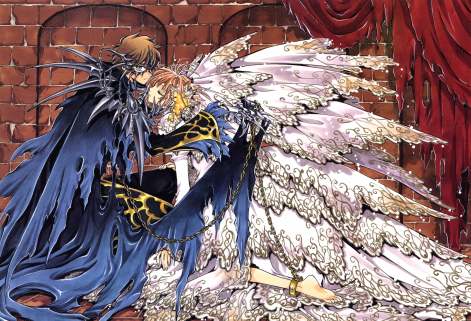

A great story, appeal for a wide range of audiences, absolutely breathtaking artwork, and good characterization make it a ‘must-read’ manga. However, the convoluted plot and the extremely depressing scenarios that occur in the second half of the manga will throw readers off-guard (though it’s a wonderful improvement compared to the boring, comedic, “gotta-catch-’em-all” feel of the first half). The storyline gradually begins to make sense after months of ceaseless pondering, but once the majority of puzzle pieces are in place, you can’t help but love Tsubasa even more. Definitely recommended if you’re a CLAMP fan, but definitely NOT recommended if you’ve never touched any of their other series.

